
Hearing Aid, Hearing Care Tips, Oticon Hearing Aid, Oticon Products, Phonak Products, Products
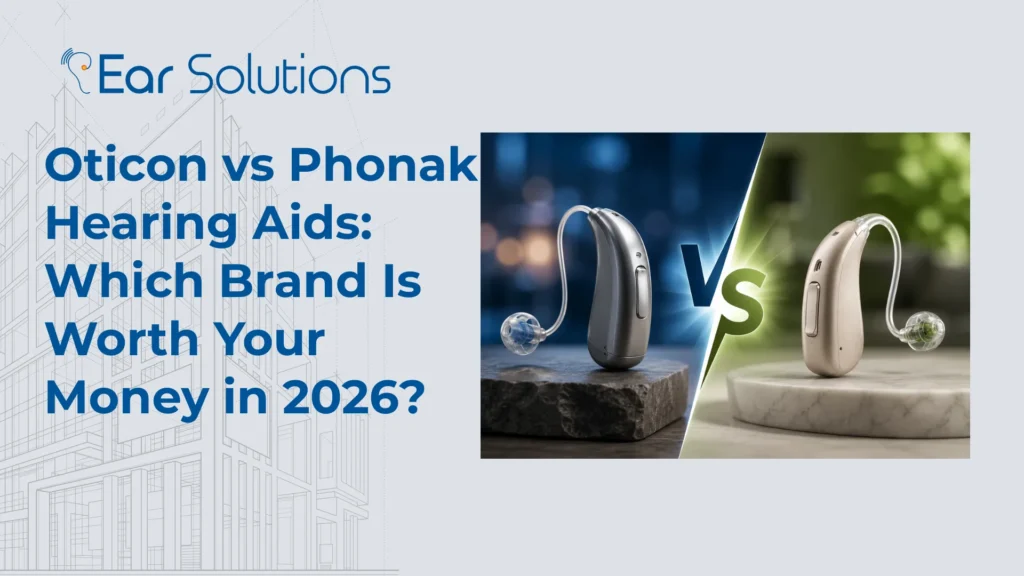
Oticon vs Phonak Hearing Aids: Which Brand Is Worth Your Money in 2026?
May
Two names come up more than any other when people start seriously researching hearing aids: Oticon and Phonak. Both have decades of history behind them. Both use genuine AI technology. Both are recommended by audiologists worldwide. And both carry price tags that make you want to be sure before you hand over your card.
So, in Oticon vs Phonak hearing aids, which one is actually better? The honest answer is that it depends entirely on who you are and how you live. This blog breaks down Oticon hearing aids and Phonak hearing aids side by side, their technology, their real-world performance, and the prices of Oticon vs Phonak so you can stop second-guessing and start hearing better.
SummaryThis blog gives you a straight, detailed comparison of Oticon vs Phonak hearing aids in 2026. It covers what makes each brand unique, how their AI works in daily life, what you will actually pay, and which type of person each brand suits best.
Key Takeaways
- Oticon and Phonak are two of the most clinically respected hearing aid brands in the world.
- Oticon focuses on natural, brain-friendly sound, while Phonak focuses on automatic environment adaptation.
- The prices of Oticon vs Phonak are broadly similar but vary based on model tier and where you buy.
- Both brands offer rechargeable batteries, Bluetooth streaming, and remote fitting options.
- The right choice depends on your lifestyle, your hearing profile, and how you prefer your device to work.
Table of Contents
Why Oticon and Phonak Keep Coming Up in Every Comparison
There are dozens of hearing aid manufacturers in 2026, but very few with the research depth, audiologist trust, and global reach of Oticon and Phonak. Oticon was founded in Denmark in 1904 and has spent over a century studying how human hearing actually works. Phonak is a Swiss brand under the Sonova group and has built its reputation on engineering reliability and acoustic performance.
When audiologists recommend hearing aids, they are thinking about two things: clinical outcomes and long-term support. Both Oticon and Phonak hearing aids score extremely well on both counts, which is why they dominate so many professional recommendations and consumer shortlists alike. The question is never whether they are good. The question is which one is good for you specifically.
Oticon Hearing Aids: The Brand, The Technology, The Experience
Oticon built its entire modern product philosophy around a concept called BrainHearing. The core idea is straightforward but genuinely different from most competitors. Rather than filtering the sound world down to what the device thinks you want to hear, Oticon hearing aids deliver a full, 360-degree sound scene to your brain and let your brain do what it naturally does: focus, filter, and follow the conversation.
The science behind this is real. Oticon hearing aid has published clinical research showing that when the brain receives a fuller acoustic picture rather than a heavily processed one, it works less hard. Listening fatigue drops. Comprehension improves. Wearers describe feeling less drained at the end of a busy social day.
Their current flagship is the Oticon Real, running on the Polaris R chip. The deep neural network inside was trained on 12 million real-world sound scenes. It does not just follow presets; it has genuinely learned from enormous amounts of real acoustic data and applies that learning in real time.
In practice, wearers notice a few things quickly. Sound feels more natural and three-dimensional. There is less of that closed-in, artificial quality that older hearing aids produced. Speech in noisy environments comes through with good clarity without the sensation that everything else has been switched off. The companion app is clean and straightforward, offering volume control, program selection, and access to remote adjustments.
Battery life on the rechargeable Oticon Real sits at up to 20 hours per charge. Bluetooth works with both iPhone and Android. The charging case is compact and provides a full charge in about three hours.
Phonak Hearing Aids: The Brand, The Technology, The Experience
The Phonak hearing aid takes a different approach, and it suits a lot of people extremely well. Where Oticon trusts your brain to do the sorting, Phonak hearing aids take on more of that job themselves through their AutoSense OS 5.0 platform, the most automatic hearing aid operating system currently available.
AutoSense works by continuously scanning the acoustic environment and selecting from over 200 processing configurations in real time. You walk from a quiet room into a busy street,t and the device adjusts before you have even registered the change yourself. You sit down at a restaurant,and it detects the reverberant noise environment and switches settings accordingly. You take a phone call, and the audio streams directly to both hearing aids. None of this requires any interaction from you.
Their Roger wireless microphone system is a standout accessory worth knowing about. Roger microphones can be placed on a table during a meeting or clipped to a conversation partner and send speech directly into the hearing aids, cutting through background noise in ways the hearing aids alone sometimes cannot. For frequent meeting-goers, it is a meaningful upgrade.
The Phonak Audeo Lumity is their flagship 2026 model. Battery life reaches up to 16 hours with active streaming. Universal Bluetooth connects to Android and iOS equally, which is something many competitors still have not achieved. The MyPhonak app allows basic adjustment and remote audiologist access.
Prices of Oticon vs Phonak: What You Will Actually Pay
Oticon hearing devices retail at approximately ₹2,55,000 to ₹4,25,000 per device, depending on the technology tier. The entry-level Oticon More sits at the lower end. The top-tier Oticon Real with full accessories sits near the upper range.
Phonak hearing devices retail at approximately ₹75,000 to ₹3,02,000 per device. Their Paradise and Lumity ranges span from mid-level to premium, with the full Lumity Life rechargeable model at the higher end.
So the prices of Oticon vs Phonak hearing aids are broadly comparable. Neither brand is the budget option. What you are actually comparing is not a significant price difference but rather which set of features and which listening philosophy represents better value for your specific situation.
A few things affect the final number. Where you buy matters. A large audiology clinic in a major city typically charges more than a regional hearing aid store or a telehealth provider. The fitting, follow-up appointments, and warranty period bundled with the device affect the total cost, too. Always ask what is included in the quoted price before comparing figures from different providers.
Insurance and benefits can reduce costs significantly. Some employer plans cover hearing aids. Veterans may be eligible for VA coverage. In certain countries, both brands are available through public health systems at reduced cost.
Oticon vs Phonak: Comparison
| Feature | Oticon | Phonak |
|---|---|---|
|
Technology
|
BrainHearing AI
|
AutoSense OS |
|
Sound Style
|
Natural, full-scene hearing
|
Adaptive speech-focused hearing |
|
Bluetooth
|
iPhone & Android
|
Universal device connectivity |
|
Battery Life
|
Up to 20 hrs
|
Up to 16 hrs |
|
Best For
|
Complex social environments
|
Everyday mixed environments
|
|
Noise Handling
|
Balanced environmental awareness
|
Strong speech enhancement |
|
Accessories
|
TV Adapter, ConnectClip
|
Roger Microphone System
|
Prices are approximate and vary by city, clinic, and model variant. Always consult a certified audiologist.
Which One Should You Choose?
Choose Oticon hearing aids if you spend a lot of time in socially complex environments like busy offices, dinner parties, or family gatherings and find that you feel mentally exhausted by the end of the day. The BrainHearing approach tends to make the most noticeable difference for people who experience significant listening fatigue and want a more natural, open sound.
Choose Phonak hearing aids if you lead a varied, fast-moving daily life and want a device that manages itself entirely without any input from you. If you frequently switch between very different environments, such as commuting, office work, outdoor activity, and restaurants, AutoSense OS handles those transitions better than almost anything else on the market. Phonak is also the stronger choice if you use multiple Bluetooth devices or want to invest in accessories like the Roger system.
Consult our expert and experienced audiologists at Ear Solutions for further concerns about which brand you should choose, as they both are excellent and have great AI features with modern technology, so it becomes hard to select one without professional guidance.
Conclusion:
The Oticon vs Phonak hearing aids debate does not have a universal winner because both brands are doing genuinely impressive things in 2026 from different starting points. Oticon trusts your brain. Phonak trusts its own automation. Both approaches work extremely well for the right person.
When it comes to the prices of Oticon vs. Phonak hearing aids, you are in a similar range; either way, you’re premium devices with premium costs. What separates them is not the number on the price tag but the experience you are buying with it.
Get a proper hearing test at Ear Solutions. Be honest with your audiologist about how you spend your days. Try both if your provider allows it. The best hearing aid is the one you actually wear every day without thinking about it, and for different people, that is a different device.
FAQs
Both perform well, but in different ways. Phonak’s AutoSense OS and Oticon’s BrainHearing are particularly strong at automatic noise management across changing environments.
Sometimes yes. Independent hearing aid stores often have more flexibility on pricing than franchise chains.
Phonak has universal Bluetooth compatibility with essentially all devices. Oticon works well with both platforms, but some advanced features are optimized for the iPhone. Check the specific model you are considering before purchasing if device compatibility matters to you.
Both brands recommend a professional clean and check every six to twelve months. This is usually quick and inexpensive at any hearing aid store.
Yes, and you should. Most reputable audiology providers offer a 30- to 60-day trial period. If your budget allows, trialling both brands sequentially in your real daily environments is genuinely the most reliable way to make the right choice.