

Hearing Aid
How Audiologists Help You Get the Best Results from an Ear Machine
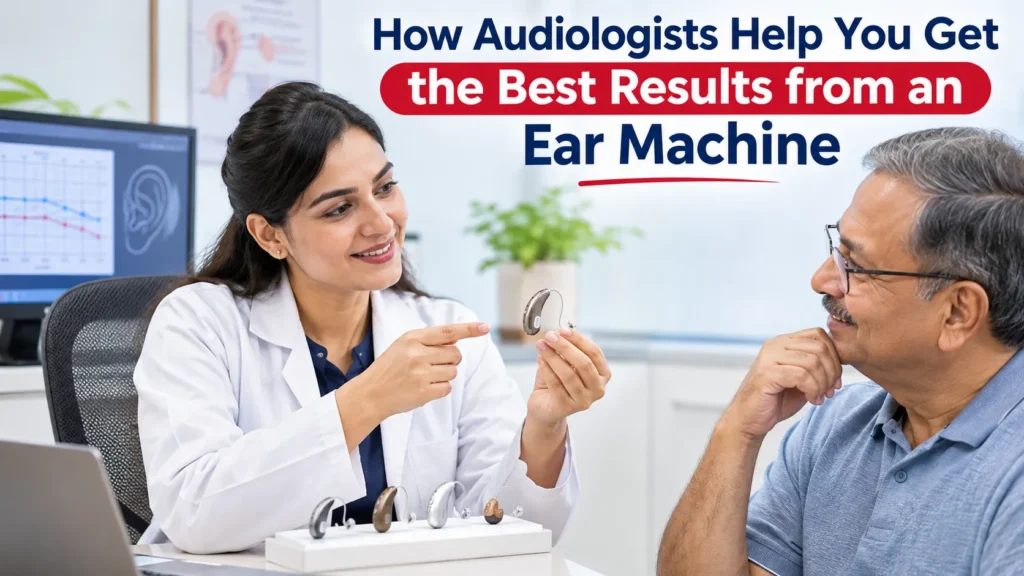
An audiologist for an ear machine tests your hearing, matches a device to your audiogram, programs it from your test results and fine-tunes it over follow-up visits. These steps often decide how well the device works for you, more than the price. At Ear Solutions in India, our audiologists handle each of them.
Two people can buy the same ear machine and get very different results, and the difference is usually the fitting, not the device. This guide shows what an audiologist does at each stage. If you are still comparing devices, our first-time buyer’s guide covers the basics.
What does an audiologist for an ear machine do?
An audiologist does five jobs that decide how your ear machine performs. The table shows each stage and what it changes for you.
| Stage | What the audiologist does | What it changes for you |
|---|---|---|
| Hearing test | Measures your hearing with a pure tone audiometry (PTA) test | Shows which pitches you miss and how much |
| Device choice | Matches style and technology level to your loss and routine | Avoids paying for features you will not use |
| Programming | Sets the device from your audiogram | Speech sounds clearer at the pitches you need |
| Trial and fine-tuning | Adjusts settings from your feedback at follow-ups | Fixes what feels too loud, sharp or dull |
| Servicing | Cleans, checks and repairs the device over time | Keeps the sound consistent as months pass |
Why does the hearing test come before the ear machine?
The test shows what your ears need, and every later decision depends on it. A PTA test usually takes about 20 to 30 minutes, and you sit in a quiet room, wear headphones and signal when you hear each tone.
The result is an audiogram, a chart of the softest sounds you can hear at each pitch. Our audiologists explain it to you before they recommend anything, and they refer you to an ENT specialist when the picture needs medical review.
How does an audiologist choose the right ear machine?
The audiologist matches the device to your hearing loss, daily routine and budget. A higher price is not automatically a better fit, because a well-programmed mid-level device can serve you better than a poorly fitted premium one. At Ear Solutions in India, we fit Signia, Phonak, Widex, Oticon, ReSound and Starkey, so we can compare devices against your audiogram.
| Band | Range |
|---|---|
| Basic | ₹24,999 to under ₹30,000 |
| Mid-level | ₹30,000 to ₹49,999 |
| Advanced | ₹50,000 to ₹1,00,000 |
| Premium | Above ₹1,00,000, up to ₹8,75,000 |
Brand starting prices run from ₹25,000 for Widex, Oticon and Starkey to ₹29,750 for Phonak. Prices are indicative and vary by model, technology and hearing loss level. We offer 0% EMI on select models, and we confirm eligibility and tenure in writing with your quote.
How does programming change the way an ear machine sounds?
Programming sets how much the device amplifies each pitch, based on your audiogram. A device left on default settings amplifies for an average listener, while a programmed device amplifies for you.
An initial fitting may take around an hour, and follow-ups are shorter.
Why are follow-up visits part of getting the best results?
Follow-ups let your audiologist adjust the device as your brain adapts to sound again. We expect several visits in the first few weeks, and each one is a chance to fine-tune what you report.
Sounds can seem sharper or louder at first, and your own voice may feel strange. Our guide on getting used to hearing aids explains the usual stages.
| What you notice | What to report |
|---|---|
| Your own voice sounds loud or hollow | When it happens and in which rooms |
| Background noise feels too loud | Which sounds, such as fans or traffic |
| Pressure or soreness in the ear | Which ear, and after how many hours |
| Whistling | When it starts, and whether the fit changed |
| Speech still unclear in a group | The place, the group size and the distance |
Ready to see what your hearing test shows?
Your audiogram is the starting point for every good fitting. Our audiologists test your hearing, explain the result and give you a quote in ₹ that you can compare.
Book Your Free Hearing Test | See Hearing Aid Prices
How can you tell your ear machine is well fitted?
A well-fitted ear machine feels comfortable and secure, and speech is clearer in the places you struggle most. These signs show a good fit:
- The device stays in place without pain or pressure after a full day.
- Conversation at home is easier than before.
- Sounds are loud enough without feeling sharp.
- Your follow-up visits are booked, and your notes are heard.
If one of these is missing, tell your audiologist rather than waiting, because adjustments are a normal part of the process, and we change the fit if the device does not sit securely. A short note on when and where the problem happens helps us fix it faster, and you can bring it to your next visit.
How does servicing keep your ear machine working well?
Servicing keeps the sound consistent, because wax, moisture and wear change how a device performs over time. Our audiologists clean and check the device, adjust the settings and arrange repairs at our clinics, so a small issue does not grow into a long gap without hearing support.
We also service and fine-tune hearing aids from other major brands. You can find the nearest of our Ear Solutions clinics and book a visit.
What should you ask an audiologist before buying an ear machine?
Ask these questions and get the answers in writing, so you can compare providers fairly.
- Who will test my hearing and fit the device? Ask for their qualification and RCI registration details.
- Which brands can you fit, so the device is not limited to one family?
- What are the trial terms, and what happens if the device does not suit me?
- Which follow-up visits and servicing are included?
- Does the quote cover one ear or a pair, and does it include the charger?
- What are the EMI and warranty terms, in writing?
When should you see an ENT specialist first?
See an ENT specialist before buying an ear machine if you have sudden hearing loss, loss in one ear only, ear pain or discharge, dizziness, or constant ringing. These symptoms need medical evaluation first. Our audiologists test hearing and fit devices, and we do not diagnose or treat ear disease.
Conclusion
The best result from an ear machine comes from the audiologist’s work as much as from the device. A careful hearing test, a device matched to your loss and routine, programming from your audiogram and follow-up visits that act on your feedback turn a purchase into hearing you can use. At Ear Solutions, our audiologists guide you through each stage, explain every option and its price in ₹, and give you a written quote, so book a free hearing test with us and start with facts.
FAQs
What does an audiologist for an ear machine do?
An audiologist tests your hearing, helps choose a device that matches your audiogram, programs it from your test results and fine-tunes it at follow-up visits. They also arrange servicing over time.
How long does a hearing aid fitting take?
An initial fitting may take around an hour, and follow-up visits are shorter. The time varies with the device and your comfort.
How many follow-up visits will I need after getting an ear machine?
Expect several visits in the first few weeks. The exact number depends on how quickly you settle in and what needs adjusting.
How much does an ear machine cost in India?
Ear Solutions lists hearing aids from ₹24,999 to ₹8,75,000, in four bands from Basic to Premium. Please confirm in writing what your quote includes and whether it covers one ear or a pair.
Why is a hearing test needed before buying an ear machine?
The test shows your hearing at different pitches, and the device is programmed from it. Ear Solutions offers a free hearing test at its clinics.