

Hearing Aid
Premium vs Advanced Hearing Aids: A Complete Comparison Guide (2026)
Jul
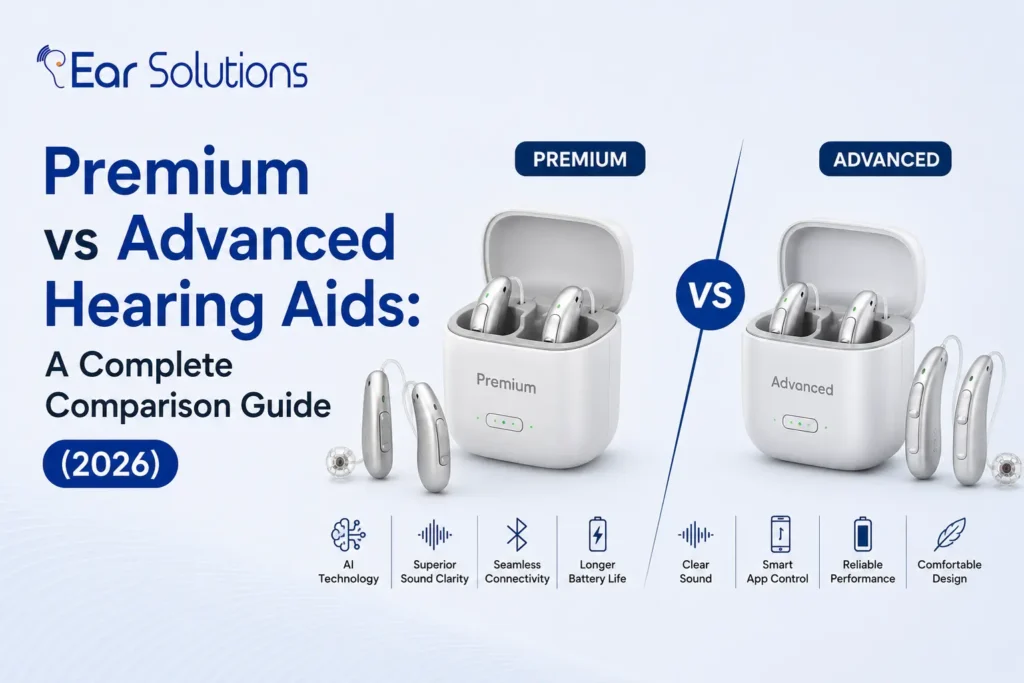
Walking into a hearing aid clinic often means facing a long list of options; there could be advanced and premium hearing aids that you can choose. This blog will help you understand what actually separates these two categories, break down the key features you should pay attention to, and make the premium vs. advanced hearing aid comparison much easier to follow.
Summary
This guide explains the real difference between premium hearing aids and advanced hearing aids, highlights the key features that matter most, and helps you figure out which category actually fits your hearing needs and budget.
Key Takeaways
Premium and advanced hearing aids are not just about price tags; they differ in technology level. The right choice depends on your daily environment, not just your budget. More features do not always mean a better fit for your specific hearing loss. A proper hearing test should guide your decision more than marketing terms. Comfort and support after purchase matter just as much as the device itself.
Table of Contents
What Do Premium and Advanced Actually Mean?
Hearing aid brands usually organise their devices into tiers, and premium hearing aids sit at the very top of that list. These devices come packed with the most advanced processing chips, the widest range of automatic adjustments, and features designed for complex listening situations like crowded restaurants or windy outdoor settings.
Advanced hearing aids sit just one step below, offering strong performance but with slightly fewer automatic features and a narrower range of sound processing scenarios.
What Are the Key Features to Look For?
When comparing devices, it helps to look closely at a few key features rather than getting distracted by brand names alone. Sound processing speed, background noise reduction, directional microphones, rechargeable battery life, and smartphone connectivity are the areas where premium and advanced models usually differ.
Premium hearing aid models often handle multiple noise sources at once more smoothly, while advanced models still perform well but may need more manual adjustment in tricky environments.
What Premium Hearing Aids Bring to the Table
Sound handling
Handles multiple background noise sources at once, smoothly and automatically
Offers noticeably better speech clarity in group conversations
Convenience
Adjusts to your environment on its own, so you’re not constantly reaching for an app.
Comes with the widest range of automatic sound settings available
Best suited for
Restaurants, meetings, or windy outdoor spaces
What Advanced Hearing Aids Bring to the Table
Sound handling
Delivers solid, reliable sound quality for everyday listening
Handles noisy places reasonably well, though may need a bit more manual tweaking
Value
An advanced hearing aid covers the essentials most people need without loading you up with extras.
Costs less while still giving dependable performance
Best suited for
A fairly steady, predictable daily routine
Premium vs. Advanced Hearing Aid Comparison: Which One Do You Need?
| Choose Premium Hearing Aids If You... | Choose Advanced Hearing Aids If You... |
|---|---|
|
Frequently visit noisy restaurants or public places
|
Spend most of your time in quieter environments
|
|
Attend business meetings or social gatherings regularly
|
Need reliable hearing support for everyday conversations
|
|
Want the highest level of automatic sound adjustments
|
Prefer excellent performance without paying for every premium feature
|
|
Need the best speech clarity in complex listening situations
|
Have a predictable daily routine
|
|
Are you comfortable investing more in advanced technology
|
Want a balance between performance and affordability |
Does Price Always Reflect Performance?
There is a point at which you should definitely take a proper hearing evaluation and diagnosis before using any kind of hearing aid. Not entirely. While premium hearing aids do cost more, that price reflects the technology inside, not a guarantee that it is the right fit for everyone.
Some people with mild hearing loss end up paying for premium features they barely use, while others with more complex hearing needs find advanced models limiting. This is exactly why a proper hearing evaluation should come before deciding on a tier.
Mistakes to Avoid When Choosing Between the Two
Choosing a tier based only on price instead of actual hearing needs. Assuming that premium hearing aids are always better for every individual. Skipping a detailed hearing test before selecting a device. Ignoring how much time you spend in noisy versus quiet environments. Not asking your audiologist to explain the real difference in key features before deciding.
Who Should Choose Premium Hearing Aids
- Your days are full of noisy restaurants, packed meetings, or social gatherings.
- You want your hearing aid to do the adjusting for you instead of doing it manually.
- Speech clarity in busy, complicated environments is something you struggle with
Who Should Choose Advanced Hearing Aids
- Most of your time is spent at home or in calmer settings
- You want dependable, everyday performance without paying extra for features you’ll rarely touch, so choose advanced hearing aids.
- Your routine doesn’t throw a lot of unpredictable, noisy situations your way.
Conclusion
Understanding the difference between premium hearing aids and advanced hearing aids comes down to knowing your own lifestyle and hearing needs. The premium vs advanced hearing aid comparison is not about which one is objectively better, but about which key features actually matter for how you live. Getting a proper hearing test and discussing your daily routine with an audiologist will always lead to a more confident decision.
FAQs
They are worth it for people who spend a lot of time in noisy or changing environments, but they are not always necessary for everyone.
Sound processing speed, noise reduction, and automatic adjustments are the main differences between the two tiers.
Yes, though they may need more manual adjustment compared to premium models in complex noise situations.
Not necessarily, since the right fit depends on your specific hearing loss and daily routine.
A proper hearing test, along with a discussion about your lifestyle, is the best way to decide.

Prerna Singh
Audiologist, Ear Solutions
Prerna Singh is an Audiologist at Ear Solutions, focused on delivering compassionate, patient-centric hearing care. She works closely with individuals to understand their hearing concerns and guide them toward practical, technology-driven solutions that improve everyday communication and confidence.
At Ear Solutions, Prerna supports the organization’s long-standing mission of transforming lives through better hearing. She is committed to hearing awareness, accurate assessments, and continuous patient support-ensuring every individual receives the care they need to hear better and live better, in line with the vision of #AbSabSunenge.