

Hearing Aid, Hearing Care Tips
Understanding the Differences Between CIC, RIC, ITC, and IIC Hearing Aid Styles
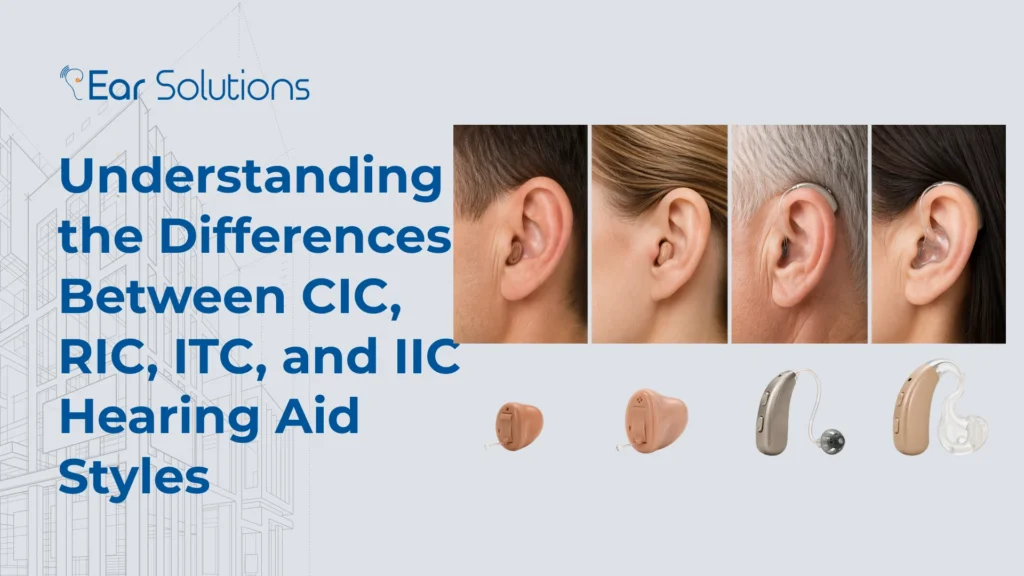
Walk into any hearing care conversation in India today, and you will very quickly find yourself staring at a wall of abbreviations. CIC. RIC. ITC. IIC. Everyone seems to use these terms freely, as though they already know exactly what they mean and why they matter. Most people nod along and then go home and quietly Google every single one of them.
If that sounds familiar, you are in the right place. Choosing the right hearing aid is not just about how well it amplifies sound. It is about how it fits into your actual life. Whether you want something completely invisible or something easier to handle. Whether you spend your days in quiet home settings or busy office environments. Whether you are comfortable with a little visibility or whether discretion is the thing that matters most to you.
The style of hearing aid you choose shapes all of that. And understanding the real differences between CIC hearing aids, RIC hearing machines, ITC hearing devices, and IIC hearing machines is the single most useful thing you can do before you walk into your first proper consultation. This guide explains all of it in plain and straightforward language, so you can arrive at that appointment already knowing what questions to ask.
Summary
This guide breaks down the four most commonly recommended hearing aid styles available in India today. It explains how each one sits in or around the ear, who it works best for, what the practical advantages and limitations are, and how to think about which style suits your specific hearing loss and lifestyle. By the end, you will have a genuinely clear picture of where to start.
Key Takeaways
- CIC and IIC focus on discretion: CIC is very discreet, while IIC is completely invisible; both are best for mild to moderate hearing loss.
- RIC is the most versatile choice: It suits a wide range of hearing loss and offers modern features like Bluetooth and rechargeability.
- ITC provides a balanced option: easier to handle than smaller styles while still offering a custom fit and good performance.
- Your lifestyle matters: Daily environment, comfort, and ease of use should guide your decision, not just appearance.
- Smaller devices have limitations: CIC and IIC may have shorter battery life and fewer advanced features.
- No single style fits everyone: The right choice depends on your hearing level, preferences, and daily needs.
- Professional guidance is key:A proper hearing test and expert advice ensure you choose the most suitable option.
Why Hearing Aid Style Matters More Than Most People Realise
Most people focus almost entirely on the technology inside a hearing aid when they start researching their options. Sound processing, noise reduction, Bluetooth connectivity, and battery life. All of that matters, and it matters quite a lot. But the type of hearing aid you choose, meaning where it sits physically in relation to your ear, shapes your entire daily experience in ways that go beyond what any chip or feature can fix.
A hearing aid that is technically excellent but physically uncomfortable will end up sitting in a drawer within a few months. A device that performs well but feels too visible for your comfort will be worn inconsistently, which means it will never deliver the results it is capable of. A style that does not suit your level of dexterity will become a source of daily frustration rather than daily support.
In India, where hearing care awareness has grown significantly in recent years but where many people are still navigating these choices for the first time, understanding hearing aid styles before you begin is genuinely empowering. It means you walk into your consultation at Ear Solutions already knowing enough to have a real conversation about what will work for your specific life rather than simply accepting whatever is placed in front of you.
What are the main types of hearing aids?
Let’s understand some types of hearing aids and their features for you so you can choose the right match for your hearing level needs under the guidance of our experienced professionals.
CIC Hearing Aids ExplainedCIC stands for Completely in the Canal. These are custom-made devices that sit entirely within the ear canal, making them one of the more discreet hearing aid styles widely available today. When worn correctly, they are not visible from the front and are barely noticeable from the side, which makes them a popular choice for people who place a high value on appearance.
Because CIC hearing aids sit so close to the eardrum, they pick up sound in a very natural way. The positioning allows them to take advantage of the ear’s own natural shape for collecting and directing sound, which many users find produces a more organic listening experience compared to devices that sit further away from the canal. Commonly known cic hearing devices are Phonak Virto Paradise and Widex Moment.
CIC hearing aids are best suited for people with mild to moderate hearing loss. They are not typically recommended for severe or profound hearing loss because their small size limits the power they can deliver. They also require a reasonable level of finger dexterity to insert and remove comfortably each day, which is worth thinking about honestly before choosing this style.
Battery life on CIC hearing aids tends to be shorter than that of larger styles because the device size limits battery capacity. Most models use small disposable batteries that need replacing every few days. Some newer CIC models now offer rechargeable options, though these are less common than in larger styles.
For working professionals, younger adults, and anyone for whom discretion is a genuine priority, CIC hearing aids are very much worth discussing with your audiologist.
RIC Hearing Aids ExplainedRIC stands for Receiver in Canal. This is one of the most widely fitted hearing aid styles in India and across the world today, and the reasons become clear very quickly once you understand how the design works.
In an RIC hearing device, the main body of the device sits behind the ear, slim and lightweight, while a thin wire runs over the top of the ear and connects to a small receiver that sits inside the ear canal. This separation of components is what gives RIC hearing aids their particular advantages. The behind-the-ear unit handles the processing while the receiver delivers sound directly into the canal, producing a clarity and naturalness that many users find immediately comfortable.
RIC hearing aids suit a broader range of hearing losses than most other styles. They work well for mild, moderate, and moderately severe hearing loss, and some models are powerful enough to manage more significant losses too. This versatility is one of the main reasons audiologists recommend them so frequently as a starting point for new hearing aid users.
The slim profile of RIC hearing aids makes them considerably more discreet than traditional behind-the-ear styles while remaining easier to handle than fully in-canal devices. The wire and receiver can be replaced relatively easily if they are damaged, which also helps with long-term maintenance costs. Most RIC models, such as Phonak Audeo Lumity hearing aids today, are available in rechargeable versions, which removes the need to manage small disposable batteries entirely.
For first-time hearing aid users in India who want strong performance, good discretion, and a comfortable daily experience, RIC hearing aids represent one of the most balanced and practical choices available.
ITC Hearing Aids ExplainedITC stands for In the Canal. These custom-made devices sit in the lower portion of the outer ear bowl and extend into the ear canal, making them larger than CIC and IIC styles but smaller and more discreet than full-in-the-ear models.
The slightly larger size of ITC hearing aids compared to CIC and IIC options brings a few practical advantages that are worth understanding. They can accommodate more power, which means they are suitable for a wider range of hearing losses, including some moderately severe cases. Their size also makes them significantly easier to handle for people who find the smaller canal styles fiddly or frustrating. Volume controls and program buttons can often be incorporated directly into the device, which is not possible with the smaller CIC and IIC styles.
ITC hearing machines are custom-moulded from an impression of your ear, which means they fit securely and comfortably once properly made. They are not fully invisible in the way that IIC devices are, but they remain relatively discreet, and most people would not notice them at a normal conversational distance.
For older adults in India who want a custom-fit device with better handling ease than the smallest canal styles, ITC hearing devices, such as Oticon OPN 1 power ITC, often represent a very sensible middle ground. They offer meaningful discretion without the handling challenges that come with going fully invisible.
IIC Hearing Aids ExplainedIIC stands for Invisible in Canal. These are the deepest-fitting and most invisible hearing aid styles available today, and for people whose primary concern is that nobody should be able to tell they are wearing a hearing aid, they represent the ultimate option.
IIC hearing aids sit so deeply within the ear canal that they are genuinely invisible from the outside. Even in a direct face-to-face conversation, no part of the device is visible to the other person. For many people, particularly those who have been putting off addressing their hearing loss partly because of concerns about how visible a hearing aid would look, discovering that IIC devices exist changes the entire conversation.
Because of their deep positioning, IIC hearing aids benefit from the ear canal’s natural acoustics in the same way CIC devices do, but to an even greater degree. Sound quality is natural, and directional hearing is well preserved, which users often find makes the overall listening experience feel very close to normal.
The limitations of IIC hearing aids are important to understand clearly before choosing this style. They are suitable only for mild to moderate hearing loss and are not appropriate for more significant hearing impairment. Phonak Virto V50 IIC aids. The very small size means they have no room for manual controls, wireless connectivity features, or rechargeable batteries in most current models. They also require more frequent cleaning and careful handling because of how deeply they sit in the canal.
IIC hearing aids are not suitable for everyone, and an honest conversation with your audiologist about whether your ear canal shape and hearing loss profile make you a good candidate is an essential first step before going down this path.
Comparing All Four Styles Side by Side
Understanding how these four styles compare across the things that matter most in daily life helps make the choice considerably clearer.
In terms of visibility, IIC hearing aids are the most invisible, followed closely by CIC, then ITC, with RIC being the most visible of the four, though still considerably more discreet than traditional behind-the-ear styles.
In terms of suitability for different degrees of hearing loss, RIC hearing machines cover the widest range, followed by ITC, then CIC, with IIC being the most limited and suitable only for milder losses.
In terms of ease of daily handling, ITC hearing devices are the easiest of the in-canal styles to manage, followed by CIC, with IIC requiring the most care and precision.
In terms of battery and power options, RIC hearing devices offer the most flexibility, including widely available rechargeable models, followed by ITC, with CIC and IIC offering more limited options in most current models.
In terms of suitability for active lifestyles with wireless and Bluetooth features, RIC hearing aids lead clearly, with ITC offering some options, and CIC and IIC having the most limited connectivity features due to their size constraints.
Differences Between CIC, RIC, ITC, and IIC Hearing Aid Styles
| Feature | CIC | RIC | ITC | IIC |
|---|---|---|---|---|
|
Full Form
|
Completely in canal
|
Receiver in Canal
|
In the Canal
|
Invisible in Canal
|
|
Placement |
Inside the ear canal
|
Behind ear + receiver in canal
|
Partly in the canal, partly in the outer ear
|
Deep inside the ear canal
|
|
Visibility |
Very discreet
|
Slightly visible
|
Moderately discreet
|
Completely invisible
|
|
Best For Hearing Loss
|
Mild to Moderate
|
Mild to Severe
|
Mild to Moderately Severe
|
Mild to Moderate
|
|
Sound Quality
|
Natural
|
Clear & powerful
|
Balanced |
Very natural
|
|
Battery Type
|
Small disposable
|
Rechargeable / Disposable
|
Mostly disposable
|
Small disposable
|
|
Bluetooth / Connectivity
|
Limited
|
Excellent
|
Limited to moderate
|
Very limited |
|
Ease of Handling
|
Moderate
|
Easy
|
Easy
|
Difficult |
|
Customization
|
Custom-fit
|
Standard + custom options
|
Custom-fit
|
Custom-fit
|
|
Comfort Level
|
Good
|
Very comfortable
|
Comfortable
|
It depends on ear canal |
|
Maintenance
|
Moderate
|
Easy
|
Moderate
|
High (due to deep fit) |
|
Best For Lifestyle
|
Discreet users
|
Active & tech users
|
Balanced users
|
Maximum invisibility seekers |
How to Choose the Right Style for Your Life
Choosing between CIC, RIC, ITC, and IIC hearing aids is not a decision that should be made based on appearance alone or on what someone else found worked for them. Every ear is different, every hearing loss profile is different, and every person’s daily life places different demands on their hearing.
Start by being honest with yourself about what matters most to you. If invisibility is your single biggest priority and your hearing loss falls in the mild to moderate range, IIC or CIC hearing aids are worth exploring seriously. If you want strong performance across a wide range of environments and a comfortable balance between discretion and ease of use, RIC hearing aids are likely to come up at the top of your audiologist’s recommendations. If you want a custom-fit device that is easier to handle than the smallest styles, ITC hearing aids offer a practical middle ground.
Think about your daily routine in concrete terms. Do you spend most of your time in quiet settings or busy ones? Do you use a smartphone regularly and want your hearing aids to connect to it? Do you have any challenges with finger dexterity that might make handling very small devices difficult? These are exactly the kinds of questions a good audiologist at Ear Solutions will walk you through, and having thought about them in advance means you can have a genuinely productive conversation rather than starting from zero.
Why the Right Guidance Makes All the Difference
Understanding hearing aid styles is an important starting point, but it is only the beginning of what goes into choosing the right device for your specific needs. The fitting process, the fine-tuning, the follow up care, and the ongoing support you receive after walking out of your consultation all play an enormous role in how well your hearing aids actually perform in your daily life.
This is why working with a team that has deep experience across all four styles and a genuine commitment to understanding your individual situation matters so much. At Ear Solutions, the focus has always been on matching the right style and technology to the right person rather than recommending whatever is simplest or most convenient. Every consultation starts with understanding your life before discussing any device, because that is the only way to make a recommendation that will actually hold up over time.
Whether you are exploring CIC hearing aids for the first time, trying to understand whether RIC hearing aids suit your lifestyle better, weighing up ITC against IIC for discretion, or simply trying to make sense of it all from scratch, having the right people in your corner makes a difference that no amount of online research can fully replace.
Conclusion:
Hearing aids have come a long way, and the four styles available today give people in India more genuine choice than ever before. CIC hearing machines offer strong discretion with natural sound for mild to moderate losses. RIC hearing devices deliver versatile performance across a wide range of hearing needs with excellent modern features. ITC hearing aids balance custom fit and comfort with easier daily handling. IIC hearing devices provide the deepest invisibility available for those who qualify.
None of these styles is universally the best. The best hearing aid is the one that fits your hearing loss, suits your daily life, and feels comfortable enough to wear consistently every single day. Getting to that answer requires an honest conversation with a skilled audiologist who takes the time to understand your situation properly.
At Ear Solutions, that conversation is exactly where everything begins. Because the right hearing aid does not just help you hear better. It helps you live better, every single day.
FAQs
CIC hearing aids sit within the ear canal and are discreet but visible up close. IIC hearing aids sit deeper in the canal and are genuinely invisible from the outside. IIC suits only mild-to-moderate losses, while CIC covers a slightly wider range.
Some RIC models are powerful enough for moderately severe hearing loss and certain severe cases. Your audiologist will assess your hearing profile and confirm whether RIC hearing aids are appropriate for your specific degree of loss.
ITC hearing aids are generally the easiest of the custom in-canal styles to handle because of their slightly larger size. RIC hearing aids are also straightforward to manage for most users.
Yes. IIC hearing aids are available in India through specialist hearing care providers. Candidacy depends on your ear canal shape and degree of hearing loss, which your audiologist will assess during your consultation.
RIC hearing aids are most commonly recommended for first-time users because they suit a wide range of hearing losses, offer strong modern features, and provide a comfortable balance between performance and discretion.